Last Updated: September 22, 2026
A Quick Guide to Pink Noise and Sleep
Article Summary:
Pink noise is a steady sound, similar to rain, that puts more emphasis on lower pitches than white noise. A new MIT study found that tiny, carefully timed bursts of pink noise increased fluid waves in the brains of 14 sleeping adults, but it did not show that playing pink noise all night clears brain waste. A separate study found that continuous pink noise may reduce REM sleep, so while it can help mask background noise, it is not an automatic sleep upgrade.
What the New Pink Noise Study Means for Your Sleep
- Part 1: What the MIT Researchers Actually Did
- Part 2: Does a Bigger Fluid Wave Mean a Cleaner Brain?
- Part 3: Pink Noise vs. White Noise
- Part 4: Pink Noise for Blocking Sounds at Night
- Part 5: Does Pink Noise Boost Memory?
- Part 6: My Take
Many people already use pink noise to fall asleep, and recent coverage of a new MIT study raised a bigger question: Can it help clean your brain while you sleep?
The short answer is no one has shown that. The researchers did find something interesting, but the way they used pink noise was very different from pressing play at bedtime.
Here is what the study actually measured, and what it means if you already use pink noise to sleep.
What the MIT Researchers Actually Did
The study, published September 9, 2026, involved 14 healthy adults. Researchers watched each person’s brain waves while they slept and played tiny, 50-millisecond bursts of pink noise at specific moments. They also used MRI to track the movement of cerebrospinal fluid, or CSF, around the brain. MIT explains how the team combined the measurements.
The timing was the key. When the sound lined up with the peak of one of the big, slow brain waves most noticeable during deep sleep, the researchers saw larger brain waves and larger CSF flow waves. They did not see the same CSF effect when the sound arrived at other points in the wave.
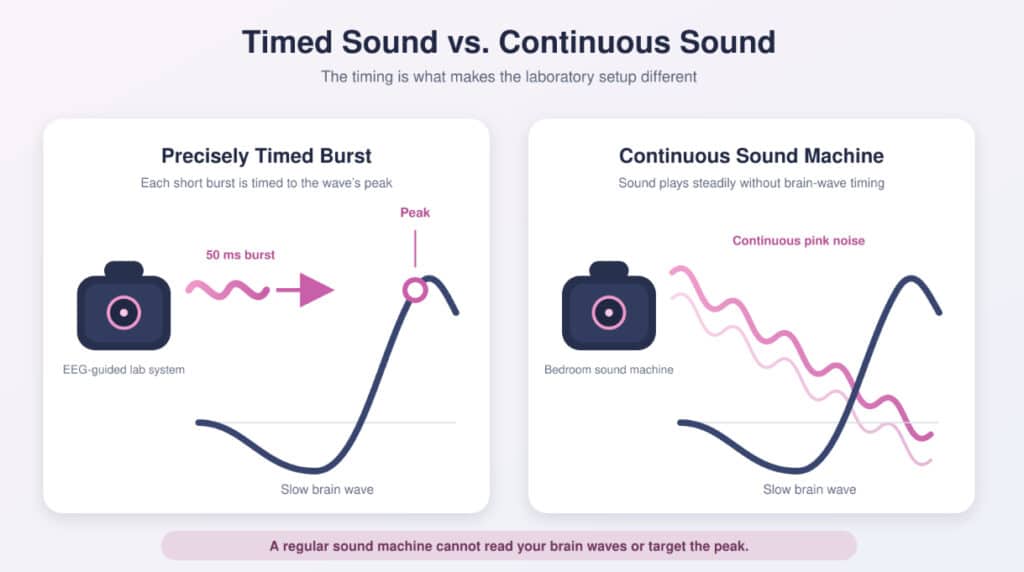
Think of giving a swing a small push at just the right moment. The researchers were trying to find that moment in a sleeping person’s brain. A regular sound machine does not know when your brain waves reach their peaks.
Does a Bigger Fluid Wave Mean a Cleaner Brain?
Not necessarily. CSF helps move substances around the brain, and scientists are studying its possible role in removing waste during sleep. But in this study, the team measured fluid movement. They did not measure how much waste, if any, was cleared from anyone’s brain.
That is where the word “detox” gets ahead of the evidence. Bigger fluid waves are a new and useful finding. They are not proof that pink noise washed away harmful proteins, improved memory, or lowered anyone’s risk of Alzheimer’s disease.
The researchers hope to explore those questions in future studies. For now, this was a small study of healthy adults, not a test of a treatment for dementia or sleep problems.
Pink Noise vs. White Noise: Is One Better for Sleep?
Both contain a mix of sound frequencies. White noise has a brighter, hissier sound. Pink noise puts relatively more emphasis on lower pitches, so many people hear it as a softer, deeper sound, a little like steady rain. That difference might affect which one you prefer at night.
The MIT study did not compare pink noise with white noise, so it cannot show that one is better for sleep. What mattered was when the sound played, not which type of noise was used.
Curious what pink noise sounds like? Here is a sample.
What If Pink Noise Helps Block Sounds at Night?
This is the everyday reason many people use it. A steady background sound may make a passing car or barking dog less noticeable. That is called sound masking, and it is separate from the brain-wave timing used in the MIT study.
The catch is that masking a sound does not always mean you sleep better overall. A review of continuous noise as a sleep aid found that the quality of evidence for a sleep benefit was very low.
Then, in a separate 2026 Penn Medicine sleep-lab study, researchers followed 25 healthy adults across seven nights. On the night with continuous pink noise at the volume tested, participants spent about 19 fewer minutes in REM sleep than on a quiet night. When the researchers added pink noise to intermittent traffic sounds, it helped with some noise-related disruptions but made the overall sleep pattern worse. Earplugs did a better job of protecting sleep under the conditions they tested.
That does not mean every person who enjoys a quiet sound machine is losing 19 minutes of REM sleep. This was a small, short study using particular sound levels. It does mean we should be careful about calling all-night pink noise an automatic sleep upgrade.
I also came across the suggestion to use a 60-minute timer. That might suit someone’s bedtime routine, but the Penn researchers studied overnight sound. They did not test whether switching it off after an hour protects REM sleep.
What About the Claims That Pink Noise Boosts Memory?
There is some promising research here, but it is again about precisely timed sound, not leaving a playlist on overnight. In one small study of older adults, participants remembered more word pairs after a night with timed sound pulses. In another study, the pulses strengthened sleep rhythms but did not improve memory-test results.
The new MIT study did not test memory at all. It gives researchers a way to study fluid waves during sleep, but we still need to see whether that change leads to benefits people can actually feel or measure.
My Take
I find this research exciting because the team did more than observe something happening during sleep. They found a way to change it. But I would not buy a pink-noise machine expecting it to “detox” my brain.
If pink noise helps you settle down, it is fine to notice that it feels soothing. I would just keep that personal experience separate from the bigger claims about brain cleaning and memory. And if you run sound all night, the Penn findings are a good reminder that more background noise is not always better sleep.
Sources
- Levitt J, et al. “Closed-loop auditory stimulation in phase with slow waves during sleep enhances cerebrospinal fluid flow in humans.” Science Translational Medicine. September 9, 2026. DOI: 10.1126/scitranslmed.aea5469.
- Massachusetts Institute of Technology. “A burst of ‘pink noise’ may lead to more restorative sleep.” MIT News. September 9, 2026.
- Basner M, et al. “Efficacy of pink noise and earplugs for mitigating the effects of intermittent environmental noise exposure on sleep.” Sleep. February 2, 2026. DOI: 10.1093/sleep/zsag001.
- Riedy SM, et al. “Noise as a sleep aid: A systematic review.” Sleep Medicine Reviews. 2021. DOI: 10.1016/j.smrv.2020.101385.
- Papalambros NA, et al. “Acoustic enhancement of sleep slow oscillations and concomitant memory improvement in older adults.” Frontiers in Human Neuroscience. 2017.
- Henin S, et al. “Closed-loop acoustic stimulation enhances sleep oscillations but not memory performance.” eNeuro. 2019.