Last Updated: October 2, 2026
Why We Used to Sleep Twice
Article Summary:
Biphasic sleep is a two-part sleep pattern that divides sleep into separate periods, often including a wakeful interval during the night. Historically documented by historian Roger Ekirch as “first sleep” and “second sleep,” this pattern was common before artificial lighting. Unlike insomnia, where wakefulness is often distressing and makes it difficult to return to sleep, biphasic sleep may feel natural and can still provide adequate rest for some people.
Biphasic Sleep: Why Waking Up at Night Isn’t Always a Bad Thing
For most of my life, I assumed a good night’s sleep meant going to bed, sleeping for eight uninterrupted hours, and waking up refreshed. As a teenager, I remember sleeping in late without thinking twice. These days, I’m lucky if I sleep until 4 a.m.
Around my 50s, I began noticing a different pattern. I would naturally fall asleep early in the evening, wake up in the middle of the night, and often stay up for a while. Sometimes, if I went to bed later or still felt tired, I would return to bed for what felt like a second sleep.
At first, I wondered if something was wrong. Was it hormones? Was I developing insomnia? Was my sleep becoming more fragmented with age?
The more I researched, the more I kept seeing one surprisingly validating idea: maybe this wasn’t broken sleep after all.
That’s when I learned this sleep style actually has a name: biphasic sleep. In simple terms, biphasic sleep means sleeping in two parts. One version includes a “first sleep” and “second sleep” separated by a wakeful window during the night. This more specific pattern is often called segmented sleep.
What surprised me most is that this isn’t some new wellness trend or proof that my sleep is broken. It’s an older human rhythm that existed long before artificial lighting, late-night screens, and the modern pressure to sleep in one perfect eight-hour block.
Learning this was incredibly reassuring.
What Is Biphasic Sleep?
Biphasic sleep means your sleep is divided into two separate periods within a 24-hour day.
For some people, that might mean a longer nighttime sleep and an afternoon nap. For others, it may look more like segmented sleep: falling asleep early, waking during the night, and either staying awake for a quiet stretch or returning to bed for a second sleep.
The important distinction is that biphasic sleep is the broader category. Segmented sleep is the historical version many people associate with “first sleep” and “second sleep.”
The Forgotten Pattern of First Sleep and Second Sleep
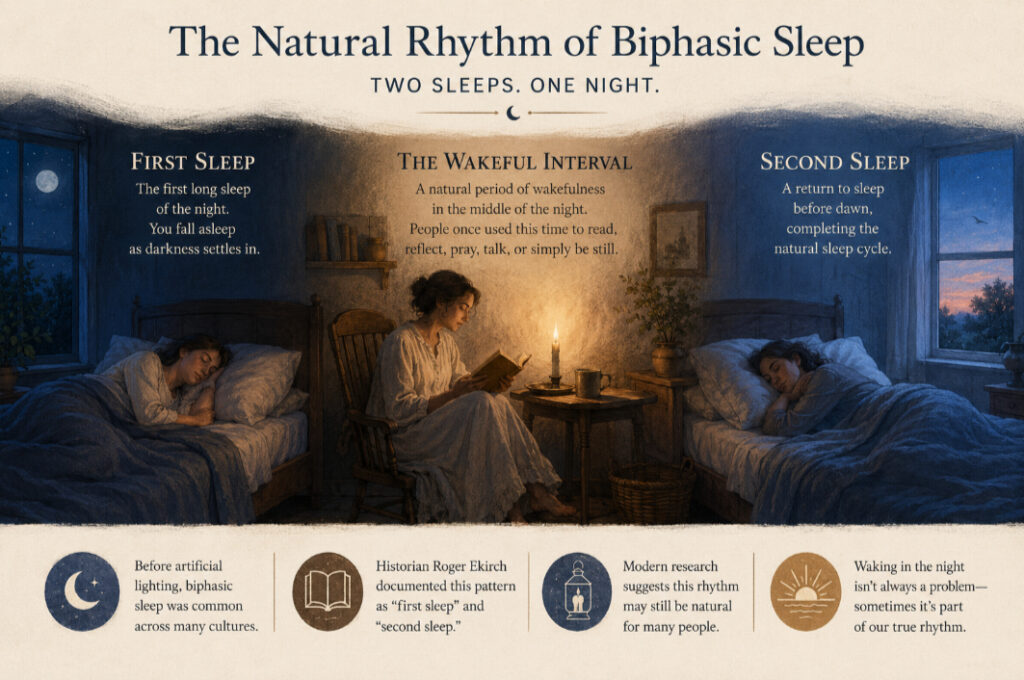
Historian A. Roger Ekirch helped bring attention to this forgotten sleep pattern in his 2005 book, At Day’s Close: Night in Times Past. While researching nighttime life before the Industrial Revolution, Ekirch found repeated references to “first sleep” and “second sleep” in diaries, medical texts, court records, and literature from pre-industrial Europe.
“It’s not just the number of references — it is the way they refer to it, as if it was common knowledge.” — A. Roger Ekirch, historian and author of At Day’s Close: Night in Times Past
Before artificial lighting became part of everyday life, many people went to bed earlier and experienced a natural wakeful period in the middle of the night. During that time, they might read, pray, reflect, tend a fire, or simply rest quietly before going back to sleep.
What many of us now see as a sleep disturbance may once have been a normal part of the night.
What Thomas Wehr’s Research Revealed
One of the most interesting pieces of modern sleep research came from psychiatrist Thomas Wehr.
“Participants described the wakeful period between their two sleeps as a tranquil interval of quiet attentiveness — calm rather than distressing.” — Findings from Dr. Thomas Wehr’s darkness study, National Institute of Mental Health
In his study, participants were exposed to 14 hours of darkness each day for several weeks. Without the usual influence of artificial light, their sleep naturally shifted into two distinct periods, separated by a quiet wakeful interval.
That does not mean everyone should force themselves into a biphasic sleep schedule. But it does suggest that sleeping in one solid block may not be the only natural way humans rest.
Why I Stopped Worrying About It
The biggest shift for me was realizing that sleep does not always have to fit one template.
Yes, sleep changes as we age. Many people experience lighter, more fragmented sleep over time. But learning about biphasic and segmented sleep helped me stop treating every early wakeup as a failure.
In my case, if I fall asleep early and wake up at 4 a.m., I don’t automatically panic about it anymore. If I feel rested, I get up. If I still need more sleep, I let myself go back for a second sleep.
That mindset change made the whole thing feel less stressful.
Biphasic Sleep vs. Insomnia
One of the reasons learning about biphasic sleep was so reassuring is that I had always associated waking up in the middle of the night with insomnia. The two can look similar on the surface, but they aren’t necessarily the same thing.
People with insomnia often struggle to fall asleep, stay asleep, or return to sleep. The wakefulness itself can become stressful, creating a cycle of frustration, anxiety, and even more sleeplessness.
Biphasic sleep can feel different. The wakeful period may feel natural rather than distressing. Some people use the time to read, reflect, meditate, or simply enjoy a few quiet moments before returning to sleep. Others, like me, may sometimes decide to start their day if they feel rested enough.
Of course, waking up during the night can still be linked to stress, medical conditions, medications, or age-related changes in sleep. The difference is how the pattern affects your overall well-being.
If you’re exhausted, struggling to function during the day, or regularly lying awake feeling frustrated, it’s worth discussing with a healthcare professional. But if you wake up, feel calm, and still get the rest your body needs, it may not be the sleep emergency many of us assume it is.
For me, that distinction changed everything. Instead of immediately assuming something was wrong, I started paying more attention to how I felt the next day. That shift in perspective helped me stop treating every middle-of-the-night wakeup as a problem that needed fixing.
The Bottom Line
If you wake up during the night or find yourself naturally sleeping in two parts, it does not automatically mean your sleep is broken.
For some people, a two-part sleep pattern may be a natural rhythm that works better than fighting for one perfect eight-hour block.
The real question is not whether your sleep looks exactly like everyone else’s. It’s whether you are getting enough total rest to feel healthy, clear, and functional during the day.
For me, the biggest relief was realizing my sleep was not necessarily broken. It may have simply been following an older rhythm my body already understood.
Sleep Examiner is for informational purposes only and is not medical advice. If nighttime waking is frequent, distressing, or affecting your daytime energy, speak with a qualified healthcare provider.