Last Updated: April 24, 2026
What You Need To Know
Article Summary: Sleep trials and warranties are often confused, but they serve very different purposes. A sleep trial lets you test a mattress at home to decide if it feels right, while a warranty protects you against defects that appear over time. Understanding how each one works, including limitations, return policies, and coverage details, can help you avoid surprises and make a more confident purchase decision.
Sleep Trial vs. Mattress Warranty: The Key Differences
Warranties matter more than most people realize. When shopping for a new mattress, it’s easy to focus on comfort, firmness, materials, and price while overlooking the fine print. Yet a mattress is a significant investment, often ranging from a few hundred to several thousand dollars, and the policies that come with it can shape your experience long after the purchase, especially if something goes wrong.
Two of the most important are the sleep trial and the warranty. They’re often mentioned together, but they serve very different roles. A sleep trial helps you decide whether the mattress feels right for you in your own home. A warranty protects you if a manufacturing defect appears later. Understanding the difference can help you avoid confusion, protect your purchase, and make a more confident decision from the start.
In This Article
- Sleep Trial vs. Warranty: Not the Same
- Key Things to Know About Sleep Trials
- When the Company Determines the Outcome
- Unpacking and Setup Requirements
- Documentation and Ownership Requirements
- Prorated Coverage Over Time
- How Trial Periods and Warranties Interact
- Quick Comparison Table
- Other Conditions to Be Aware Of
- How to Better Understand a Warranty
- When Filing a Claim
- The Bottom Line
Sleep Trial vs. Warranty: They’re Not the Same
When buying a mattress, especially online, most companies offer a sleep trial. This gives you time to test the mattress at home and decide whether it’s the right fit for your body, sleep position, and comfort preferences.
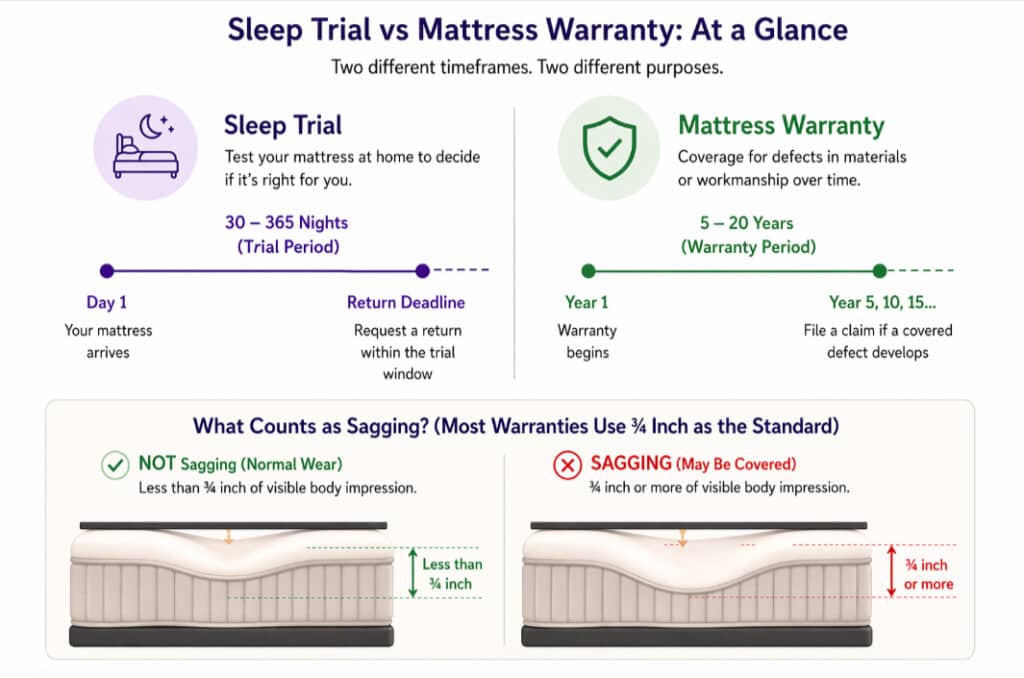
Trial periods usually range from about 100 nights to a full year. Many brands also require some kind of break-in period, often around 30 nights, before you can request a return. That’s because mattresses need time to fully expand after shipping, and your body also needs time to adjust to a new sleep surface. A mattress that feels strange on night one may feel very different a few weeks later.
What varies more than the trial length is how returns are handled. Some companies offer full refunds with free pickup, while others may charge return shipping, recycling fees, or restocking fees. These details are not always obvious upfront, but they can make a real difference if the mattress does not work out.
A sleep trial is about comfort and compatibility. It gives you a chance to answer one simple question: Can you actually sleep well on this mattress? It does not exist to cover defects, structural issues, or long-term product failures.
Key Things to Know About Sleep Trials
The headline number, whether it is 100 nights, 365 nights, or something in between, only tells part of the story. The fine print can shape the entire experience.
It’s important to understand whether there is a mandatory break-in period, how returns are started, whether exchanges are allowed, and whether any costs apply. Some companies require the mattress to be in clean condition. Others may be more flexible. Return policies can also vary by location, especially for buyers outside the contiguous United States.
Some brands make the return process simple. Others require more back and forth, more documentation, or more patience. That does not necessarily mean the company is being difficult, but it does mean that a generous sounding trial period is not always as generous in practice as it looks in marketing copy.
The purpose of a sleep trial is straightforward. It gives you time to evaluate the mattress in real life, not just on paper or in a showroom. But the process behind it is not always as simple as the headline suggests, which is why it is worth reading the details before you buy.
When the Company Determines the Outcome
One common feature across mattress warranties is that the manufacturer determines whether a product qualifies as defective. This is standard industry practice, but it is something most buyers do not think about until they need to file a claim. That also means small details can make the difference between an approved claim and a denied one.
Because defect definitions can be specific, measurements matter. For example, many warranties require visible sagging to meet a set threshold, often ¾ inch or more, measured with a straightedge across the surface and without anyone on the mattress. If the impression falls just short of that measurement, it may be classified as normal wear instead of a defect.
This does not automatically mean a claim will be handled unfairly, but it does mean that documentation matters more than many buyers expect. Clear photos, proper measurements, and a detailed description of the issue can make the process smoother if a problem arises.
It also helps to understand that a mattress can feel unsupportive or uncomfortable before it technically qualifies as defective under a warranty. That gap between how a mattress feels and how a company defines a defect is one of the main reasons people confuse sleep trials and warranties in the first place.
Unpacking and Setup Requirements
Warranty coverage often depends on how the mattress is set up from the beginning. Many brands include specific requirements around unpacking timelines, foundation support, and overall bed frame compatibility.
Some policies require the mattress to be unboxed within a certain window to prevent issues related to prolonged compression. Others specify that the mattress must be used on a supportive, non-flexing base with slats no more than a few inches apart and adequate airflow underneath.
If those conditions are not met, the warranty can be voided, even if the issue seems unrelated. That can come as a surprise to buyers who assume any reasonably solid bed frame will be fine.
This is one reason the setup details matter more than people think. Before using a new mattress long-term, it is worth confirming that your bed frame, platform, adjustable base, or foundation meets the brand’s requirements. A few minutes spent checking this upfront can save a lot of frustration later.
Documentation and Ownership Requirements
Another area that tends to get overlooked is documentation. Most warranties require proof of purchase, and many also require that the law tag remain attached to the mattress.
In addition, warranties are usually non-transferable. They apply only to the original purchaser and do not reset if a replacement mattress is issued under warranty. So if a company replaces a mattress in year six, that does not necessarily mean a brand new warranty starts over from year one.
These requirements are fairly standard, but they can create problems if records are lost over time. Many buyers assume they will never need the receipt again, only to find out years later that it is required for a claim.
Keeping digital copies of receipts, order confirmations, and warranty documents can make a significant difference if an issue ever comes up. It is one of the easiest ways to protect yourself without doing much extra work.
Prorated Coverage Over Time
Many mattress warranties are structured in two phases. The early years are usually non-prorated, meaning a defect may be repaired or replaced at little to no cost. After that, coverage becomes prorated.
With prorated coverage, the value of the warranty decreases over time. Instead of a full replacement, you may receive a percentage of the original purchase price toward a new mattress. That percentage usually declines as the mattress ages. By the later years, the coverage can be significantly reduced, even if the warranty is still technically active.
This is one of the most misunderstood parts of long mattress warranties. A 20-year or 25-year warranty can sound impressive, but that does not mean you have full protection for all 20 or 25 years. In many cases, the most valuable portion of the warranty is concentrated in the early years.
That does not make a long warranty meaningless. It just means the real value depends on how the terms are written, when proration begins, and what the company actually offers if a defect appears later on. Understanding how the prorated portion works gives you a much more realistic picture of what to expect.
How Trial Periods and Warranties Interact
Although sleep trials and warranties are separate policies, they can overlap during the early months of ownership.
If a mattress feels uncomfortable, that is usually something addressed during the trial period. Once that window closes, comfort related concerns are no longer covered.
If a structural issue appears, the warranty may apply instead. The key is recognizing the difference early, because waiting too long can limit which option is still available to you.
This is why it helps to pay close attention during the first few weeks and months. If the mattress feels wrong, document what you are noticing. If there is visible sagging, unevenness, or another problem, measure it and take photos. Early awareness gives you more options.
Quick Comparison: Sleep Trial vs. Mattress Warranty
| Aspect | Sleep Trial | Mattress Warranty |
|---|---|---|
| Main Purpose | Test comfort and fit | Cover manufacturing defects |
| Typical Duration | 100 nights to 1 year | 10 to 25 years |
| What It Covers | Comfort and preference | Sagging, structural issues |
| Common Limitations | Return fees, break-in period | Proration, setup requirements |
| Best Time to Use | First 1 to 3 months | After the trial period ends |
Other Conditions to Be Aware Of
Some warranties include additional conditions that may vary based on location, mattress type, or the specific model purchased. Certain terms may differ for international buyers or for mattresses with hybrid or specialty constructions.
There may also be exclusions related to stains, misuse, improper care, or damage caused by an unsupported foundation. In some cases, something as simple as visible staining can complicate a claim, even if the stain has nothing to do with the actual defect.
These conditions are common across the industry, but they reinforce the same point: the warranty is only useful if you understand the terms before you need to rely on it.
How to Better Understand a Mattress Warranty
When evaluating a mattress warranty, it helps to look beyond the headline length.
The duration matters, but so do the details around coverage, exclusions, and how claims are handled. A long warranty may look reassuring, but its real value depends on what counts as a defect, how the company measures that defect, whether the coverage becomes prorated, and what conditions can void the agreement altogether. The FTC recommends consumers look beyond warranty length to understand what’s actually covered, what can void the agreement, and how the company handles claims in practice.
Looking at customer experiences and the company’s overall reputation can also provide helpful context. Checking recent reviews can give you a better sense of how consistently a company stands behind its warranty in real world situations. This matters because the written warranty is only part of the picture. How a company handles claims in practice matters too.
It also helps to keep your expectations realistic. A warranty is not a promise that the mattress will feel the same forever. It is a limited agreement covering specific types of defects under specific conditions. Knowing that upfront makes it easier to judge the policy clearly.
Keeping a copy of your warranty alongside your receipt, both physically and digitally, is a simple step that can save time later.
When Filing a Claim
If you need to file a warranty claim, start by reviewing the warranty terms to confirm that your issue is actually covered.
From there, you will usually need to provide documentation, including photos, measurements, and proof of purchase. Being clear and organized helps streamline the process. If the company asks for additional information, respond as specifically as possible and keep copies of all communication.
Most claims take time to evaluate, so patience is often part of the process. That said, being patient does not mean being passive. Good records, accurate measurements, and clear follow-up can all help move things along more effectively.
If the issue appears during the trial period, it is also worth asking whether a return or exchange makes more sense than starting a warranty claim. Sometimes the best route depends less on the problem itself and more on the timing.
The Bottom Line
A sleep trial helps you determine whether a mattress feels right. A warranty protects you if something fails over time. Both matter, but they solve different problems at different stages of ownership.
The sleep trial is your opportunity to decide whether the mattress works for your body and preferences. The warranty is your backup if the mattress develops a qualifying defect later on. Knowing how each one works and where the limits are can help you avoid surprises and make better decisions before and after you buy.
Taking a few extra minutes to review these details before purchasing a mattress may not be the most exciting part of the process, but it can save you from frustration later. And when you are making a purchase that affects your comfort, sleep quality, and budget, that extra clarity is worth it.
Frequently Asked Questions
What is the difference between a sleep trial and a mattress warranty?
A sleep trial lets you test a mattress at home to see if it feels right, while a warranty protects you against manufacturing defects that develop over time. One is about comfort, the other is about product failure.
Does a mattress warranty cover comfort or firmness issues?
No. Warranties typically cover only defects such as sagging or structural problems, not whether the mattress feels too firm, too soft, or uncomfortable.
Can you return a mattress under warranty?
Not usually. Warranties are for repair or replacement if a defect is approved, not returns. Returns are handled during the sleep trial period, not under warranty.
This article was copyedited by LuLu Ciccarelli.