Last Updated: October 8, 2026
What is the best mattress for side sleepers?
Article Summary:
The best mattresses for side sleepers balance pressure relief and spinal support to cushion the shoulders and hips without letting the body sink out of alignment. Most side sleepers feel best on medium to medium soft mattresses, though body weight can change how firmness feels. Memory foam, hybrid, and latex mattresses are popular options because they contour to pressure points while maintaining stability through the midsection. Choosing the right mattress materials, firmness level, and pillow support can reduce shoulder pain, hip pressure, and lower back tension for more comfortable, restorative sleep.
What Are the Best Mattresses for Side Sleepers?
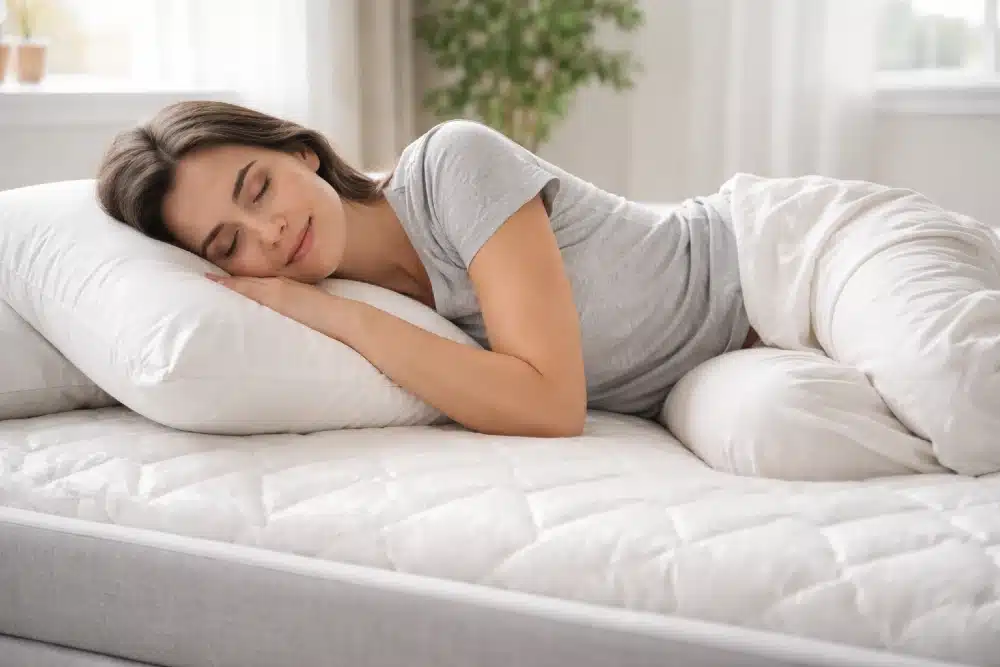
Side sleeping is one of the most common sleep positions, but it also places unique pressure on the body. When you sleep on your side, much of your weight concentrates around the shoulders and hips. Without the right balance of support and cushioning, these areas can experience pressure buildup that leads to discomfort, numbness, or even lower back strain.
Finding the best mattresses for side sleepers starts with understanding how your body interacts with the mattress surface. The right mattress should allow the shoulders and hips to sink slightly while still supporting the natural curve of the spine. When that balance is achieved, pressure points are reduced and the body can remain properly aligned throughout the night.
Why Side Sleepers Need the Right Mattress
Side sleepers place more concentrated pressure on certain areas of the body than back or stomach sleepers. The shoulder usually presses into the mattress first, followed by the hips. These areas carry a large portion of body weight, which means the mattress must provide enough cushioning to absorb pressure without sacrificing support.
If a mattress is too firm, the shoulders and hips cannot sink in enough. This often leads to pressure points and can cause the spine to tilt out of alignment. Many side sleepers notice this as shoulder soreness, stiffness in the upper back, or numbness in the arms.
On the other hand, a mattress that is too soft may allow the hips to sink too deeply into the surface. When this happens, the spine curves downward instead of remaining neutral, which can lead to tension in the lower back.
A well-designed mattress for side sleepers distributes body weight more evenly across the surface. By combining supportive base layers with pressure-relieving comfort materials, the mattress can reduce stress on joints while still keeping the spine properly supported.
Our Top Mattress Recommendations for Side Sleepers
Below are specific models we’ve reviewed that consistently perform well for side sleepers, especially around shoulder and hip pressure relief, alignment, and long term comfort.
Helix Midnight Luxe (Hybrid)
Firmness rating: 4 to 7 out of 10
Key materials: Memory foam comfort layers, zoned coils, pillow top feel
Pros
- Excellent pressure point relief for shoulders and hips
- Zoned support helps keep the spine aligned for side sleepers
- Good motion isolation for couples
Cons
- Edge support is not as strong as some firmer hybrids
- Not ideal for budget focused shoppers
- Possible initial off gassing smell
TEMPUR Adapt (Memory Foam)
Firmness rating: About 6.5 out of 10, medium
Key materials: TEMPUR ES comfort layer, TEMPUR material layers, high density support base
Pros
- Deep contouring that reduces shoulder and hip pressure
- Strong motion isolation
- Classic memory foam feel for side sleepers who like a slow response
Cons
- Can sleep warm compared to latex or hybrids
- Premium price point
- Not ideal for sleepers who want bounce
Nolah Natural (Latex Hybrid)
Firmness rating: About 6.5 out of 10
Key materials: Organic cotton, wool, Talalay latex, zoned coil support system
Pros
- Exceptional pressure relief for shoulders and hips, especially for side and back sleepers
- Sleeps cool with breathable organic cotton, wool, latex, and coils
- Eco friendly materials with minimal off gassing and a responsive, easy to move on feel
Cons
- Firmness can be divisive; some stomach sleepers over 200 lb report hip sink, while others say it feels too firm
- Edge support can weaken under heavy pressure like sitting on the side
- 120 night trial has a 99 return fee, plus occasional delivery or minor quality issues reported
Leesa Legend (Hybrid)
Firmness rating: Medium firm, about 5.5 to 6 out of 10
Key materials: Organic cotton and Merino wool cover, ventilated polyfoam, memory foam, zoned microcoils, pocketed steel coils
Pros
- Deep contouring that relieves pressure at the shoulders and hips
- Standout motion isolation for side sleeping couples
- Responsive coils make repositioning easy
Cons
- Premium price point, one of Leesa’s priciest hybrids
- Cooling is moderate rather than exceptional
- Some owners report softening or indentations after 18 to 30 months
Back Science Series 2 (Hybrid with Lumbar Support)
Firmness rating: 7 out of 10, with lumbar support rated 9 out of 10
Key materials: Lumbar Flex zoned lumbar support, gel and hypergel foams, individually wrapped coils, Quantum edge support
Pros
- Excellent spinal support that helps prevent midsection sinking
- Balanced firmness supports back, side, and stomach sleepers
- Strong edge support for stability
Cons
- May have a mild new foam smell at first
- Not bed in a box, full size delivery can be less convenient
- Premium price point
Back Science Series 3 (Hybrid Built for Side Sleepers)
Firmness rating: Medium, about 5 out of 10
Key materials: 5-inch Hypergel comfort surface, Lumbar-Flex zoned lumbar support, individually wrapped coils, Quantum edge support
Pros
- Deep pressure relief for the shoulders and hips where side sleepers need it most
- Medium, plush feel with zoned lumbar support to keep the spine aligned
- Strong reinforced Quantum edge support
Cons
- The most foam-heavy Back Science, so it can sleep a touch warm
- Premium price point, the priciest Back Science model
- Not bed in a box, full size delivery can be less convenient
| Mattress | Firmness | Mattress Type | Price Range | Warranty & Sag |
|---|---|---|---|---|
| Helix Midnight Luxe | Medium (4–7/10) | Hybrid | $1,099 – $2,299 | 15 Year Limited (1.5 inch sag) |
| TEMPUR Adapt | Medium (6.5/10) | Memory Foam | $1,699 – $3,398 | 10 Year Limited (0.75 inch sag) |
| Nolah Natural | Medium-Firm (6.5/10) | Latex Hybrid | $1,900 – $3,400 | Limited Lifetime (1.5 inch sag) |
| Leesa Legend Hybrid | Medium-Firm (5.5–6/10) | Hybrid | $1,979 – $3,130 | Limited Lifetime (1.5 inch sag) |
Educational Resources:
Sleep Foundation – Side Sleeping: Benefits and Considerations
Cleveland Clinic – Best Sleeping Positions for Spinal Alignment
Johns Hopkins Medicine – Choosing the Right Mattress
MORE SLEEP TIPS: